Next weekend, about 200 attendees at Blucifer’s First Rodeo will leave with hats commemorating the first iteration of the festival, displaying our city’s beloved blue mustang on both camouflage and black truckers.
Below Blucifer, you’ll see the designer’s name, Ryuju Collective. But even before you notice that name, you’ll see the signs: seemingly hand-drawn block letters, a depiction of Blucifer hinting at both early popular culture and vintage Denver Broncos iconography.
For those who know Ryuju Collective’s work, in-your-face playfulness combined with hand-drawn edge and just enough tongue-in-cheek allusion for those who “get it” to recognize a reference are clear indications. And as Ryuju Collective continues to grow, those signature details will only become more and more familiar within Denver’s art scene.
After all, Joshua Thorson, the man behind Ryuju Collective, practically bleeds authenticity. Beyond the team at Blucifer’s First Rodeo, he’s regularly collaborating with artists across the city from every medium: prominent clothing designers, music producers, film makers, you name it. Just this year, he created a short film with the multimedia production company We Are Prophecy, hosted a hand-stitching class at Friendly Collective Studios, created custom wardrobe pieces for artists including singer songwriter LOKANA and returned to his middle school to teach screen printing to their Art Club. He’s constantly trying new mediums, taking on new projects and meeting new creatives.
In other words, he’s a natural community builder. And in speaking with Thorson, it’s obvious why: he exudes a rare, certain warmth that makes even a first conversation feel like a catch-up between old friends. He’s hesitant to take himself too seriously, a to-the-bone Pisces who’s quick with an offer of relatability, of collaboration, of a free t-shirt fresh off his press.
It’s the kind of confidence born from being exactly where he’s supposed to be, doing exactly what he’s supposed to do. He’s a born-and-raised artist with a spirit of rebellion and the fine-tuned skillset to match.
Even still, when it comes to building his legacy, Joshua Thorson is just getting started.
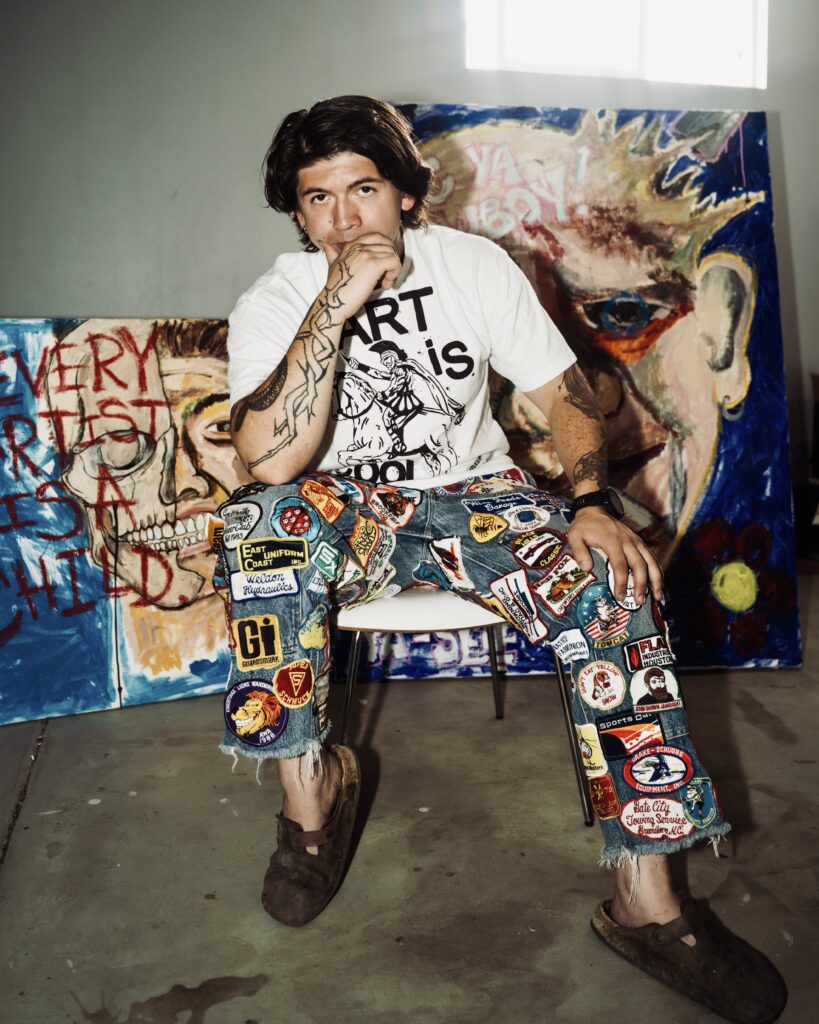
Though Thorson is making a name a for himself s a clothing designer in Denver’s style scene, he’s a multidisciplinary artist spanning a spectrum of mediums. As one of about thirty artists chosen to contribute a custom painting for the Colfax Art Walk in 2026, he found many in his circle were surprised to learn that his skills extend beyond needle and thread.
In reality, painting and drawing were his first art forms, starting in his mother’s art studio in early childhood.
“Most people know me as a clothing guy, but I’ve been doing fine art and drawing for my whole life, before I could walk,” said Thorson. “I didn’t learn to ride a bike until I was 12. I was truly always in the house with my mom in her studio.”
His mother is classically trained, having attended one of Tokyo’s most prestigious art schools and moving to the United States to complete her Master’s Degree in Art. Growing up in her studio, Thorson learned unbridled creativity early, observing both his mother’s expert skill and ability to translate her emotions onto a canvas.
She encouraged her son to do the same, giving him space to experiment with her professional grade art supplies without stress. This boundary-free creation left Thorson with a number of lessons early on that laid the foundation for his artistic process today.
“I was never given any boundaries in the art world. She’d be doing these crazy big pieces with these stupid expensive oil pastels and then letting her four or five year-old son do the same,” he shared.
And while this experience taught him the value of high quality art materials, it also taught him that the value of his creativity far outweighs any price tag. Though his relationship with utilizing expensive materials ebbed and flowed throughout his early 20s, he’s come to treat his creativity with the same lawless attitude his mother passed on: oil pastels are meant to be used. His artistic spirit is meant to be channeled into creation.
“I had oil pastels wrapped up in a box forever, saying, ‘I don’t know what I’m going to do with it. I need to have this perfect project for it. And now I’m just like, ‘let’s just burn through this,’” Thorson shared. “If I run out, I run out. The product is worth leaps and bounds instead of putting certain things on a pedestal because materials cost so much. I think one thing I’ve learned in my later 20s is actually valuing what I do, even if it’s not monetary.”
Nevertheless, it helps that when Thorson does use these materials, he knows what he’s doing, as not all lessons his mother taught him are quite so abstract. Instead, Thorson gained an eye for refiinement early. After all, his mother is a classically trained artist, and, while she encouraged Thorson to create without boundary, she also offered expert guidance toward his developing skills.
READ: Inside An Artist’s Closet: Elisabeth Strunk Talks Personal Style

“I was receiving artist critiques at such a young age that it taught me to fine tune everything. My mom was like, ‘no, that doesn’t look like a hand. The proportions are off,’” Thorson recalled. “It’s not that she didn’t like what I did, but she would just be like, ‘okay, let’s redraw this hand.’”
And while he remembers initially misunderstanding her direction as dislike for his work, he now acknowledges how this guidance shaped him into the artist he is today: never settling for “good enough,” and infusing his work with a reverent sort of respect, ensuring he’s not just creating with authenticity but skill.
Despite his early training, however, Thorson’s perspective on his identity as an artist shifted throughout his life. Growing up in the Midwest as the son of a Japanese immigrant, he felt like an outlier: not seeing any one else who shared his Asian heritage and always feeling like his talents were weighed against his outsider status.
“My graduating class was around 22 kids. Me, my brother, and my mom were the only Asian people for miles,” Thorson shared. “I grew up with so much of this weird back and forth because I was Asian. Stupid shit, like ‘Oh, Jackie Chan,’ or whatever. I got that disrespect, but since I was good at art and good at sports, it was this weird balance. I never really understood praise or validation.”
It wasn’t until he left the Midwest for a more diverse region – not only in ethnicity but in open-minded acceptance – that he began to consider art as a possible career path.
After leaving Illinois and living in Iowa briefly, he moved to Atlanta to work on set for Netflix original productions such as Stranger Things and Cobra Kai. Atlanta’s ethnic diversity and vast queer communities opened Thorson’s eyes to the possibilities beyond his white-washed hometown.
“I was like, ‘Oh, a place like this can exist,’” said Thorson. “In Atlanta, I realized I can be an artist. Don’t get me wrong. It’s not easy. You can’t just be like, ‘Okay, I’m just going to do it.’ But I was starting to do it.”
In Atlanta, he began forming relationships that launched his trajectory as an artist. One relationship in particular, with his now long-term partner Taylor, became pivotal to coming into his own as an artist. They met shortly after Thorson moved to Atlanta and have been together ever since. As such, Taylor has not only witnessed Thorson’s success: she was one of the first to encourage him to take himself seriously.
“I was always telling people, ‘Oh, I’m a big time artist,’ before I was really making shit,” Thorson shared. “And I remember she humbled the fuck out of me. She said, ‘you tell people that you’re an artist, but you’re not reallyliving that life. It took me forever to really take that in.”
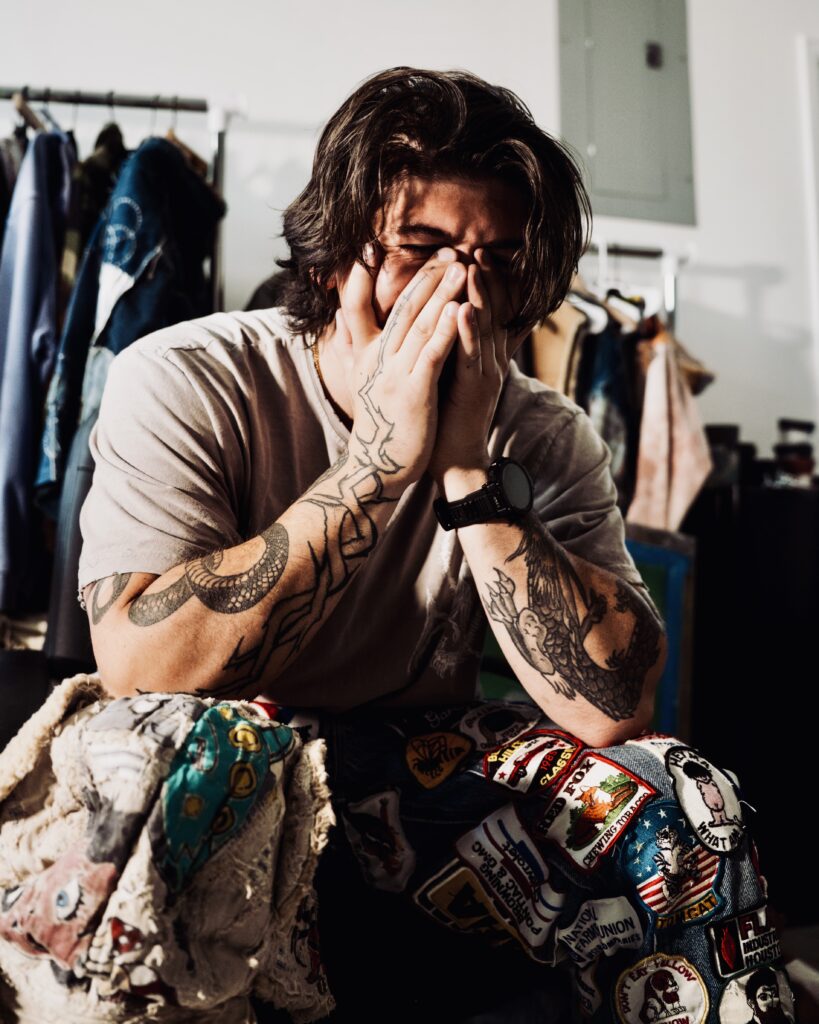
After that moment of tough love, Thorson began changing his reality. He and Taylor moved to Colorado, where Thorson continued painting and began seriously designing clothing under his label Ryuju Collective. Though he dabbled in design in college (with some prints of his senior project still out in the world somewhere), in Denver, he found a community that helped him unlearn the resistance to praise he developed through his experience in the Midwest.
“It truly wasn’t until I moved here and started really pursuing art more that I was like, “Oh, these people like me for who I am but also what I can create.’ It took me forever to understand,” he recalled. “I think truly it has been the friends and the community that developed that’s also led to my success in anything.”
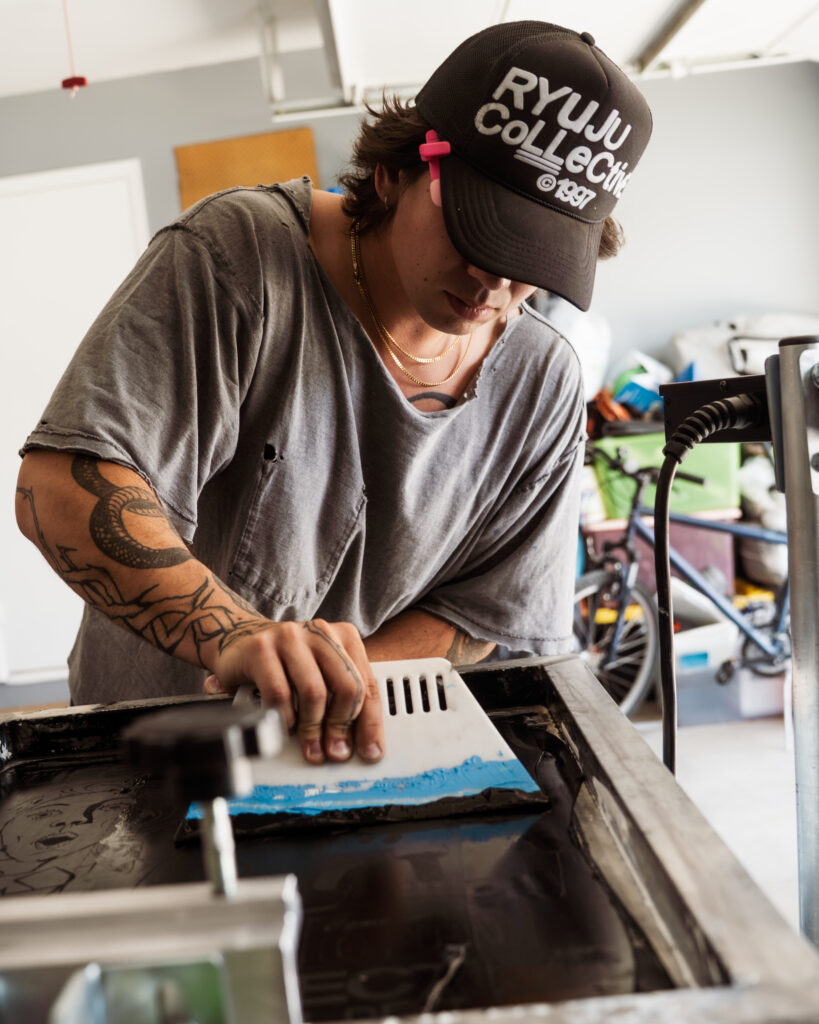
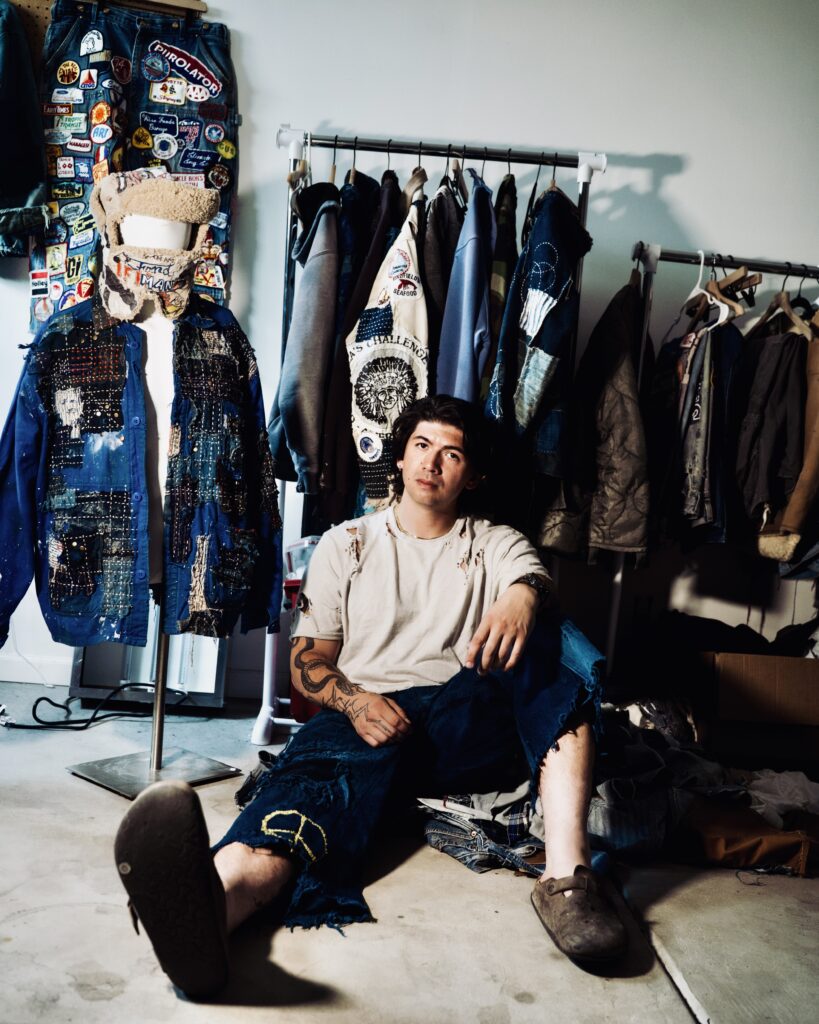
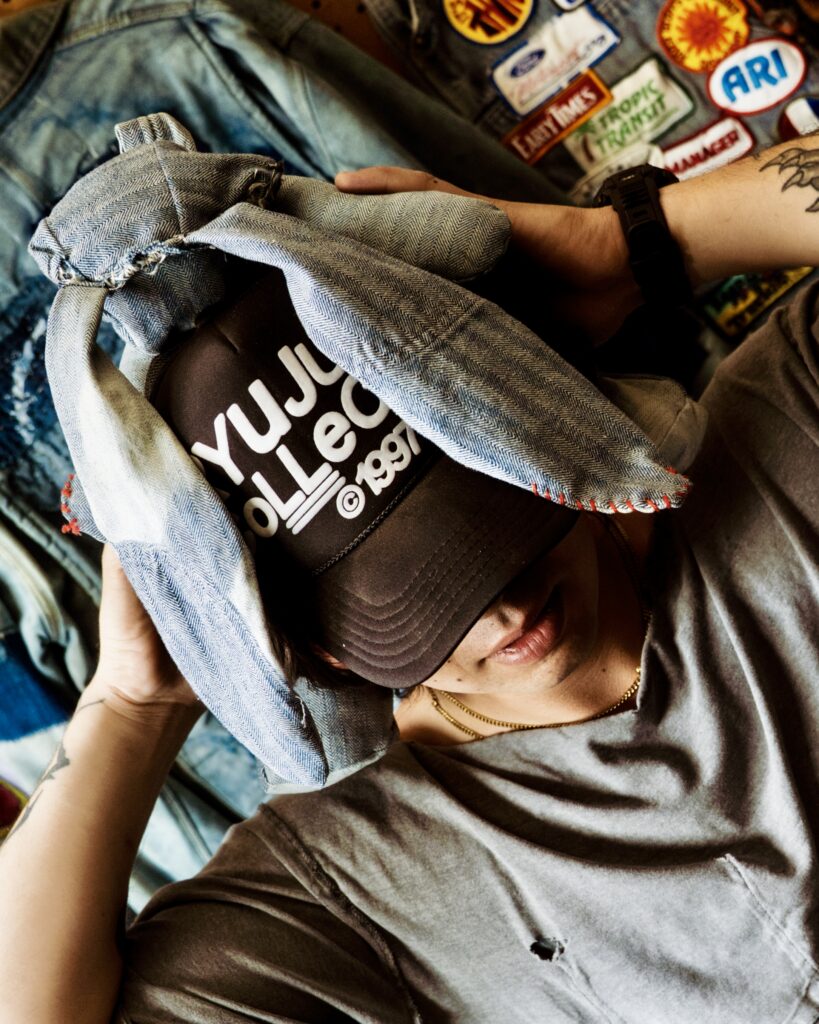
It helps that Taylor remains solidly in his corner. Just like her encouragement in Atlanta, it seems she offers a new sort of balance in Thorson’s life: seeing through his blindspots and making sure he stays grounded.
“She keeps me on my toes. She keeps me sane and healthy,” said Thorson. “I will do bender, especially when I’m paintin. I’ll paint for 6 hours straight, and she’ll come in from work and say, ‘hey, have you left the garage all morning? hey, have you eaten anything?’”
It’s from that support – from his partner and from the connections he’s found in Colorado – that Thorson and Ryuju Collective continue to grow. In building community, Thorson found the confidence to turn the skills he’s build since childhood into a successful career. Plus, in surrounding himself with artists, he had no choice but to trust his unique artistic vision, learning that standing out in a city of artists means creating authentically.
“A lot of people make music. A lot of people make clothes, a lot of people do graphic design. A lot of people do photo, video, but I think the biggest thing – and what I’ve tried to do in this last four years – is how do I stand out?” Thorson said. “I know a ton of people that screen print. I know a ton of people that do patchwork clothes. Why am I so special?”
In reality, the answer likely won’t be found in a medium no one else touched or a technique no one else can replicate (although, Thorson may be one of very few in the Denver Metro with a vat of indigo dye in his house – another Ryuju Collective signature). Instead, Thorson’s ability to stand out in a city of artists lies in his willingness to follow creativity wherever it leads, and the unique experiences that influence how that creativity manifests.
In looking back on his upbringing, he saw his mother process her experiences through art. He observed as she made sacrifices for her children, setting aside an art career to pursue teaching and acting as Thorson and his brother’s rock after the passing of her husband, Thorson’s father.
Knowing that same artistic blood in his veins, Thorson carries that legacy forward.
“I tell my mom I sometimes feel that it’s sort of like my duty to pursue this artist life even deeper than she did,” he shared.
As he imagines the future, he has no intention of setting that inheritance aside. After all, the name “Ryuju Collective,” is a nod to his heritage. Ryuju is Thorson’s middle name, meaning “Dragon Tree” and chosen by his grandfather for the Japanese name of a Buddhist philosopher.
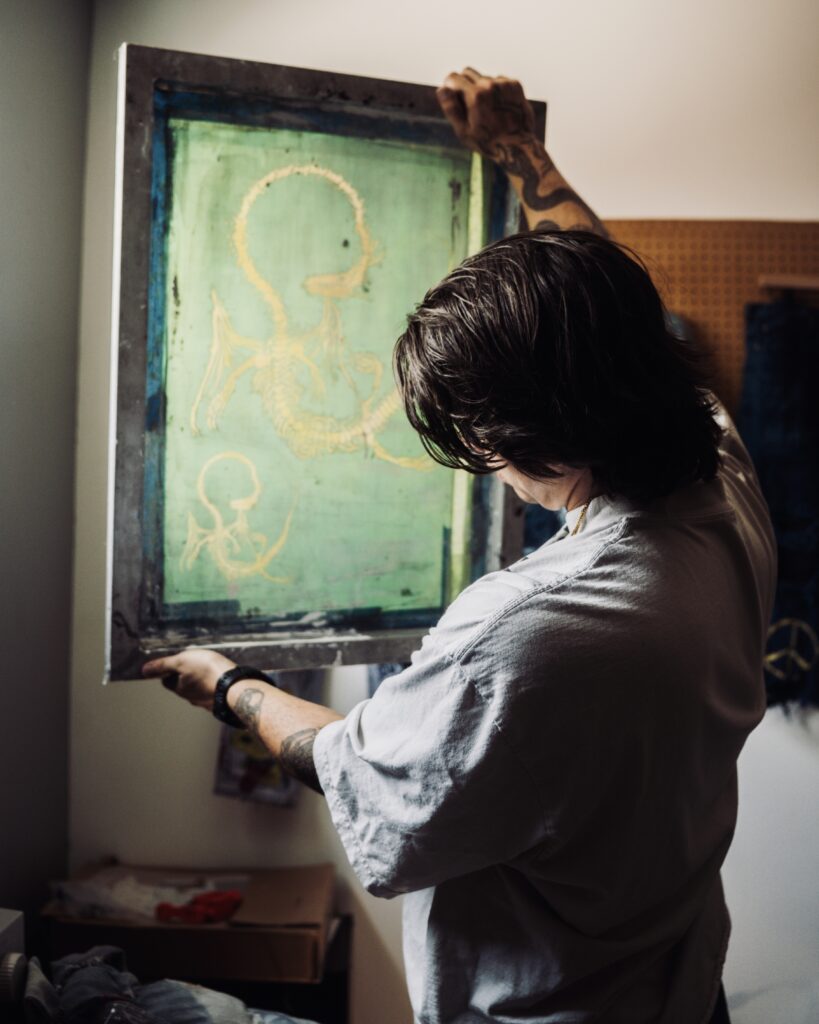
With that heritage front and center, Thorson creates his own legacy, building a unique world with his designs, no matter the medium. Whether it’s screen printing, hand stitching, painting or the next new artistic skill he learns, the spine of Ryuju Collective has been and always will be authenticity. In pouring emotions into creation, in fine-tuning designs until they reflect his particular vision and in remaining nested in community, he refuses to stray from his personal lens.
In the end, that’s what makes Ryuju Collective unmistakable. The creations reflect the artist behind them.
All photos by Helen Yoseph for Denver Dive. Follow The Pink Garage on Instagram for a studio tour with Joshua Thorson.